

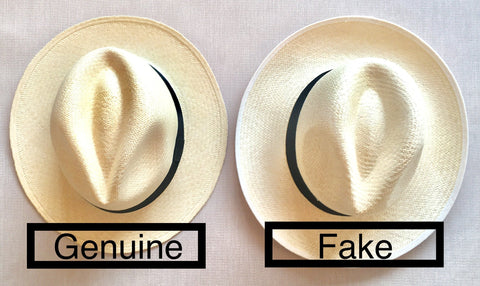
Written and curated by Guglielmo Incisa di Camerana, Master Hatter and Co-Founder of Marchesi di Montecristi (Member of the British Fashion Council). Drawing upon traditional European millinery expertise and our house’s direct ties to master weavers in Ecuador, this guide provides the definitive authenticity standard for luxury Panama hat collectors
Knowing how to spot a fake Panama hat is essential before investing in an authentic masterpiece. Genuine Panama hats are meticulously handwoven in Ecuador using natural Toquilla straw (Carludovica palmata), an art form recognised by UNESCO as Intangible Cultural Heritage. However, the global market is flooded with mass-produced counterfeits made from paper, synthetic raffia, or inferior palm fibers originating from India, Peru, Colombia, and Mexico.
Originating from the coastal province of Manabí and the historic weaving enclaves of Montecristi and Cuenca, authentic Ecuadorian Panama hats are celebrated worldwide for their extraordinary lightness, breathable weave, and timeless elegance. Worn throughout history by discerning figures such as Sir Winston Churchill and Franklin D. Roosevelt, true Montecristi hats represent the pinnacle of quiet luxury.
Beyond classic natural and bleached ivory tones, contemporary master artisans also dye genuine Toquilla straw using rich organic pigments, ranging from deep indigos to sun-warmed ochres, uniting centuries-old heritage with refined modern millinery.

Carrying forward a legacy that spans generations, master artisans in the historic coastal province of Manabí and the highland city of Cuenca keep this intricate hand-weaving tradition alive, where only 2,000 hats are produced every year.


But like in almost everything, the fake market exists alongside the genuine one. Imitations of the hat are mostly made in India, Peru, Panama, Colombia, Mexico, Japan, and Taiwan.
For those who value uncompromising craftsmanship, here are 8 expert ways to know if a Panama hat is real.
1. Examine the Raw Material (Toquilla Straw vs. Synthetic & Paper Counterfeits)
Imitations are made from cheap natural fibers like Iraca, Tetera, or Enea, and frequently from paper, raffia, or plastic. Authentic Panama hats are exclusively woven from genuine Toquilla straw (Carludovica palmata). Unlike synthetic alternatives, natural Toquilla fibers feature subtle, imperceptible variations that demonstrate pure artisan craftsmanship, comparable in their natural perfection to precious diamonds.
2. Inspect the Central Rose at the Crown Center
Look closely at the apex of the hat's crown. A genuine Panama hat always starts with a handwoven circular "rose" (roseta) where the weaver initiates the process. Mass-produced machine copies lack this signature circular starting rose, featuring square, rectangular, or machine-pressed triangular seams instead.

3. Test for the Distinctive Natural Botanical Scent
Because genuine Panama hats are hand-crafted from wild-harvested coastal Toquilla palm leaves, an authentic hat carries a subtle, unmistakable natural distinct flowery-botanical scent. Synthetic and paper imitations emit either a chemical industrial odour or no natural aroma at all.
4. Check for a Traditional Hand-Back-Woven Brim Edge
Inspect the perimeter of the brim. Authentic Montecristi and Ecuadorian Panama hats feature a seamless "back-woven" brim (remate) completed entirely by hand using the same straw fibers. Fake Panama hats utilize cheap machine shortcuts—such as a sewn cloth-bound edge, a machine lock-stitch, or glued under-welts.

5. Evaluate Weave Density and Uniform Light Transmission
Hold the hat up to a light source to inspect the weave pattern inside the crown. Master-woven hats feature a tight, uniform weave structure with minimal gaps between straws. High weave density indicates superior fineness, strength, and durability. (Learn here about the types of weaves, which one is better and durable?)
6. Verify Official Origin Stamps and Weaver Signatures
Authentic Ecuadorian hats bear a brown origin guarantee stamp applied post-weaving in Ecuador. Check the inside tags or labels that guarantees the origin. The finest ones may even have the weaver's signature hidden there.

7. Understand True Rollable Qualities vs. Permanent Storage
While authentic Panama hats (especially those woven in a herringbone / llano weave) can be loosely rolled or folded into a travel box for trips, they should never be stored permanently rolled. Storing straw under prolonged compression damages the natural fibers and alters the crown shape. Rolling a genuine Panama hat should always be for the convenience of travel only, as it would lose its shape and might require ironing to recover the original shape. The herringbone weave type is the most robust and suitable to be rolled up. (Click to Learn more about Panama Hat's Qualities and Weaves)

8. Safe Reshaping and Maintenance Protocol
Original Toquilla straw hats can be cleaned gently using a damp cloth or baby wipe in circular motions. To restore structure or smooth out brim curvature, authentic Panama hats can be lightly steam-ironed using a protective cotton press cloth. (Watch a Panama Reshaping Video Here)
Keep in mind that a genuine Panama hat is an individual masterpiece of craftsmanship, it has been conscientiously hand-woven from a natural fibre, so treat it as such.
Frequently Asked Questions
Q: How do I spot the central rose on a genuine Panama hat?
A: Look for the circular center where hand-weaving begins versus a square/triangular grid on fakes.
Q: What straw is used in authentic Panama hats?
A: Genuine Toquilla straw / Carludovica palmata from Ecuador.
Q: How should the brim edge of a real Panama hat be finished?
A: Hand-woven back-woven brim, never machine-stitched or glued.
Q: Can a genuine Panama hat be rolled for travel?
A: Yes, for travel convenience, but never stored rolled permanently.